
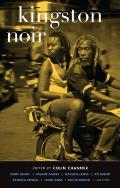
 Last night, Kingston
Noir was launched in the US at Greenlight Bookstore in Brooklyn. Colin Channer, the editor of the anthology
and Christopher John Farley read from their stories; other contributors include
Kwame Dawes, Patricia Powell, Kei Miller and Marlon James. The collection is broken into three sections
and each story focuses on different neighborhoods in Kingston. The noir
collection by Akashic books features many other cities and countries, among
them Brooklyn, Haiti and Trinidad. Channer said, “Kingston is not in the
anthology because it’s dangerous but because it’s phenomenally
interesting.”
Last night, Kingston
Noir was launched in the US at Greenlight Bookstore in Brooklyn. Colin Channer, the editor of the anthology
and Christopher John Farley read from their stories; other contributors include
Kwame Dawes, Patricia Powell, Kei Miller and Marlon James. The collection is broken into three sections
and each story focuses on different neighborhoods in Kingston. The noir
collection by Akashic books features many other cities and countries, among
them Brooklyn, Haiti and Trinidad. Channer said, “Kingston is not in the
anthology because it’s dangerous but because it’s phenomenally
interesting.” Thursday, June 14, 2012
Last night, Kingston
Noir was launched in the US at Greenlight Bookstore in Brooklyn. Colin Channer, the editor of the anthology
and Christopher John Farley read from their stories; other contributors include
Kwame Dawes, Patricia Powell, Kei Miller and Marlon James. The collection is broken into three sections
and each story focuses on different neighborhoods in Kingston. The noir
collection by Akashic books features many other cities and countries, among
them Brooklyn, Haiti and Trinidad. Channer said, “Kingston is not in the
anthology because it’s dangerous but because it’s phenomenally
interesting.” 
Sunday, November 13, 2011
The Passing of a Track and Field Giant
 |
| Courtesy of The Gleaner |
The sprints may be fast races but to be good you've got to be in the race for a long time. Howard Aires, was the embodiment of this. For over 25 years he served as either the president or vice president of the Jamaica Athletics Administrative Association.
I first met Aires in 2008, when I covered the Jamaican Olympic trials as a reporter for Sports Illustrated. I interviewed him and he never forgot my face. Since then I have attended several track and field meets at the National Stadium in Kingston and it was always good to see him and talk. He was always gracious when he saw me: smiling, reconnecting from the last time we spoke, or introducing me to someone he thought I should know.
His presence at the stadium was a given. He sat in the VP section of the grandstand seats, orchestrating any deficiencies he saw in the meet. He sat with his wife, former schoolmates who were his lifelong friends, and friends in politics and athletics.
Of all the meets at the stadium, I think he will most be missed at Champs. His seat was in the section which Kingston College men have possessed for years. He wasn’t just an official but would be perched at the edge of his seat cheering and screaming, as the other spectators would be, at the athletes.
I always thought watching he and his friends were inspiring. They sat with their wives and old friends, and were all committed to supporting the young athletes pouring their hearts out on the track and field. They didn’t just sit as wizards, with years of knowledge ready to disperse, but as people who were emotionally invested in the success of Jamaican athletics.
Just as Jamaican sprinters are being acknowledge as some of the best in the world; Aires should be acknowledge in his contribution to this success. He was committed to the athletes long before it was fashionable. He saw the talent and ability of the young men and women in the sport and dedicated his life towards enhancing them.
Thursday, September 1, 2011
Jamaica Athletics Administrative Association/Supreme Ventures National Senior Championships
Before Jamaica's fastest men raced in Daegu, South Korea, they first had to race in Kingston. Here's the reaction of the local fans.
Sunday, August 28, 2011
Usain Bolt disqualified from World Championships in Daegu
It had to happen. A big athlete is disqualified from the finals of a major track and field event.
Usain Bolt has now false started in the men’s 100m finals at the World Championships in Daegu, South Korea and won’t be able to defend his 2009 title.
For better or worse Bolt’s elimination from the 100m finals might cause the IAAF to reevaluate its one false start rule.
It was such a disappointment to watch Bolt strip his shirt off his back knowing he was out of the race. His leaving the race seemed to be the end in one long travesty in the marquee event. The missing faces of Tyson Gay, Steve Mullings, Michael Rogers and Asafa Powell already diminished to race to me.
An easy win is sometimes not the best win. Although I assumed Bolt would win the race without much, effort I wanted there to be athletes to make him run his best race -- athletes who wanted to be champion just as bad as him.
Now Bolt’s elimination brings the one start false rule before the IAAF officials. Clearly he had a lot of thoughts going through his mind while at the line, but how thoroughly should he, and others who false start, be penalized for them is now the question.
It seems the rule makers want athletes to deliver faster times, without the help of steroids, and to run the biggest race of their lives without nerves.
I did like how Bolt took the disqualification though. He didn’t complain or petition the officials but quickly left the track so the other athletes could race.
Although he's not the 100m champion, if he successfully defends his 200m title the win might still help to make him the legend he has said he wants to be.
Yohan Blake, has now legitimized himself as a true Jamaican champion. The absence of his training partner, Bolt, a lane from him didn’t frazzle Blake. Instead, when he rose to his top speed he ran with everything and beat American Walter Dix and Kittitian Kim Collins.
Blake’s win should not be diminished because of Bolt’s false start. Instead, he rose to the occasion and ran his race to be champion. That can never be taken from him.
Wednesday, August 10, 2011
Positive test for Jamaican sprinter
I was in the hardware store when I heard the news. The cashier couldn’t focus on ringing up my products. She was too busy talking to herself. “I’m going to have a heart attack if it’s true,” she repeated over and over. This was around 4:30pm, and it was raining outside. I was tired and just wanted to leave but asked her, ‘if what’s true?’
Then she relayed the rumor she heard. The drug results for one of Jamaica's sprinter was reportedly positive. If true this would be the second time the athlete would have submitted positive results.
I told the cashier not to have a heart attack. It was a figure of speech but she was clearly hurt. The news was very personal to her as though a family member or close friend betrayed her. Her eyes were glazed over and she just kept mumbling and talking to herself.
I too was shocked. I felt betrayed as a track lover by an athlete of the sport. Yet again the sport is tainted by drugs just days away for the world championship. The beauty and grace of athletics is comprised for reasons known only to the sprinter. I felt sad for the athlete, for it would be hard to recover as a professional sprinter should this be true.
The athlete’s positive test result came from Jamaica’s National Senior trials for the IAAF World Championships which were held five weeks ago.
Suspicion by international observers has never completely been off the incredible performance by Jamaica’s biggest sprinters. However, there was an increasing willingness by fans and observers to believe the claims by the sprinters of running pure. This does give some validity to the testing program in Jamaica as the discovery was made by Jamaican doping officials.
No one will ever truly know who is pure or not, because if an athlete and their team wants to cheat it’s very hard to detect. However, what I do know is that the cashier at the hardware store was seriously distraught. This was the only news that mattered to her.
I know she will spend the night venting her anger, thoughts and sadness to friends. It will be a few days before she recovers. Hopefully, she’ll be fine by the time of the World Championships and be able to enjoy athletics again.
Saturday, June 25, 2011
Jamaica Athletics Administrative Association/Supreme Ventures National Senior Championships

The excitement of the 100m finals didn’t disappoint the spectators at Jamaica’s National Senior trials for the IAAF World Championships in Daegu, Korea this August. Asafa Powell and Veronica Campbell-Brown won the finals in a tight race and amidst controversy.
The men’s race came down to a photo finish with Asafa Powell, winning the finals (10.08) while Yohan Blake (10.09) and Steve Mullings (10.10) secured the other spots for the upcoming championships.
Usain Bolt, reigning world champion in 100m and 200m, received an automatic bye to the World Championship and chose not to run.
Although it rained lightly throughout the night, grandstand seats were sold out. Spectators in the uncovered areas of the grandstand and the bleachers sat content under their oversized umbrellas.
The men’s 100m was the most anticipated race in the week. With seven Jamaicans running under 10 seconds this year, fans in the country weren’t sure who would qualify for the team. Someone would have to be cut. It’s an embarrassment of riches for a country to even have the discussion of cutting someone who can run under 10 seconds.
Saturday, April 30, 2011
Fire in Babylon
 Last Tuesday, Fire in Babylon premiered in New York at the Tribeca Film Festival. The documentary, written and directed by Stevan Riley, highlighted the dominance of the West Indies cricket team in the 1970s and 1980s.
 Team members talked about their, 5-1, loss to Australia in the 1975-76 test, and that being the beginning of their transformation. Many felt Australia deliberately bowled the ball not to get a wicket but to bowl their heads off or leave bodily scars. When the test was finished West Indies recruited fast bowlers and went from being derogatively known as Calypso Cricketers to eventually having the best fast bowlers and batsmen in test cricket.
Riley only spoke to members of the team saying he wanted the film to be “totally authentic by allowing the West Indies to tell the story.” Clive Lloyd, the first black captain, and Vivian Richards among other team members spoke of experiencing racism in Australia and England by other players and fans. Some spoke of not making an adequate living and choosing to play in South Africa against the apartheid ban and the wishes of their teammates, while others played in the World Series Cup.
The film mainly focuses on the pride the players developed while playing for West Indies. “Here we are several dots on the map and we are dominating the world,” said fast bowler Andy Roberts. He and the team went from being a laughing stock to being feared. Now they were the team inflicting harm with their bowlers. Suddenly rules were changed and they were accused of "bringing the game in disrepute.”
Other West Indies members felt a test against England was an opportunity to beat the Englishmen who were once their slave masters and inventors of the game. “It was like slaves whipping the asses of our masters,” said one player. Another said, “we wanted to show the Englishman ‘you brought the game to us and now we’re better than you.’ ”
The colorful film is loaded with Mento, Reggae, Dub poetry and Calypso singers and songs and addresses the importance of some of Bob Marley’s African liberation lyrics. But the most colorful player is fast bowler Roberts, who said when he was playing he never showed emotions so the other team wouldn’t know what to expect. In a deadpan manner he acts as though he didn’t know how dangerous his balls were and said, “I didn’t go out to hit people is just that a lot of people got hit.”
West Indies dominated the game for 15 years, never losing a test match in that time.
West Indies dominated the game for 15 years, never losing a test match in that time.
Fire in Babylon will be in theaters this summer.
Subscribe to:
Posts (Atom)